In about May 2025 I was building an automatic gain control circuit for an analog electronics course at UNSW[1]. While I wont go into the details of the circuit, I did have to purchase some signal diodes such as some 1n4148, 1n34a and 1n60p diodes. Later that year I was cleaning out my desk and realised I had an abundance of these diodes that I wasn't using, and I didn't really know what to do with 300 diodes - so I listed some on eBay.
About a month later in November, I woke up to a notification from eBay, I got my first sale! I was kind of surprised someone even bought it. Not that there was anything wrong with the diodes (or so I thought at the time), I was more surprised that people bought electronics off eBay. Some students at my University team up and do 'order runs' at DigiKey, combining all the items they want into a single order just so they can avoid the (super expensive) $20 shipping cost for orders above $60. I originally bought the diodes from eBay (yes, i know), but its because I needed the parts ASAP via express post, and eBay had the parts I needed for a reasonably cheap price compared to Jaycar - I had just thought that most people would buy from AliExpress since their shipping to Australia has speed up so much (it takes about a week after I order something from AliExpress for it to arrive at my door).
I went downstairs to my desk, super chumped that I had received an order, and began preparing to send the diodes. Unfortunately I had ran out of envelopes (or, well my parents did. I think the last time they sent an envelope was in 2010), and so I kindly asked my dad to pick some up on his way back. And you might be thinking, envelope? Well yeah, the diodes I ordered from eBay came in a DL sized envelope with a folded piece of paper and a bunch of diodes taped across - and so I followed in the eBay seller's footsteps.
I packed the diodes in an envelope as soon as my dad came back, and I went to my nearest Aus. Post and paid $1.70 (yes, $1.70!!) to get my envelope stamped, and sent it on its way to the buyer in Queensland.
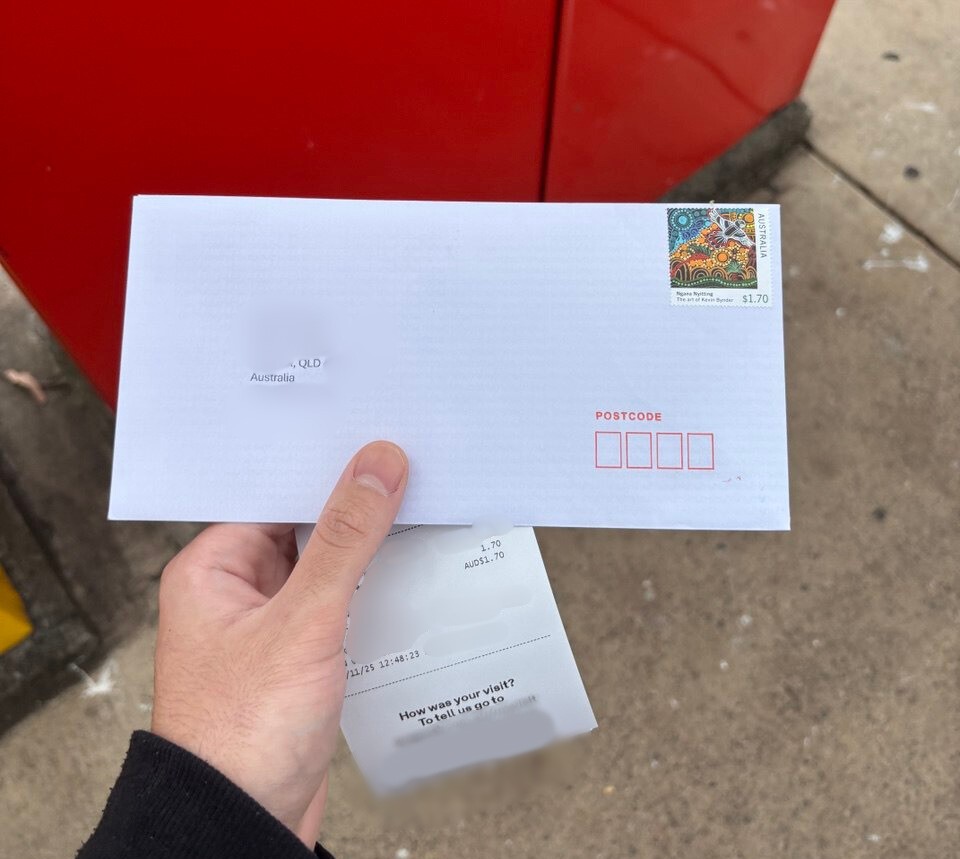
All in all, I had actually lost money from that order - the diodes originally cost me $2 + $1.70 in postage from the original eBay seller to me, and then $0.05 for the envelope and another $1.70 from me the the buyer of the diodes. Talk about business am I right!
As soon as I got home, I began taking pictures of the other diodes that I had bought from eBay. And as I was researching what to price these items at to undercut all the other sellers, I found the 1n60p diodes that I had were not exactly the real deal.
The original 1n60 (without the p) is a germanium contact point diode. This diode became part of the JEDEC (Joint Electron Device Engineering Council) standard, and basically meant any company could reproduce these diodes and slap the 1n60 name onto it. Sylvania, an American electronics manufacturer is said to be first to manufacture these diodes, and other companies such as Toshiba and Hitachi reproduced these diodes afterwards.
The main thing to pull out from the history of the 1n60, was that it was made using germanium, and as such had a characteristic 'cat whisker' (the thin wire between the anode and cathode).

Not all germanium diodes (visibly) have this whisker, (see this really nice display), but many do.
The 1n60p diodes (with the p) I had on hand did not have that cat whisker, and looked identical to the 1n34a diodes that I had. So what was up? The diodes I actually had were Schottky silicone diodes. They had essentially the same forward IV characteristics as a germanium diode (i.e. 300mV forward voltage @ 1mA), but had slightly different IV curves in the reverse direction. See this video here for more details: IMSAI Guy: #1752 1N34 Germanium vs Schottky Diodes.
So thats the only difference? Aren't they basically identical for the normal use case? Well... yes. But a lot of audio heads will tell you that germanium diodes sound nicer when used in any audio application. I myself cant actually hear any difference - many people cant hear a difference, but I wouldn't go around saying that on audio forums.
side note:
for crystal radios / AM demodulators using a germanium diode makes the audio sound much better compared to using the Schottky diodes. I watched this video, where the creator mentioned that Schotkky diodes are really bad at attenuating signals, and when used in a crystal radio they sound very fuzzy, and attract alot of 'static noise'. So maybe the secret sauce is in the germanium metal...
You can read a bit more about the difference here, where you will also be able to see a nice comparison between Si and Ge diodes (the 1n60 and 1n34 are said to be equivalent - so you can compare the Si 1n60 in the graph with the Ge 1n34). Another difference to note is that Ge diodes will have some reverse leakage current (a couple As), while Schottky diodes generally will not.
Ultimately, this whole eBay experiment has been a crash course - not just in logistics and postage costs, but in semiconductor history. I may have accidentally bought "fake" germanium, and I definitely lost money on that first sale, but the deep dive into 1950s diode manufacturing was worth at least a few dollars.
I still have about 250 of these diodes left. If anyone needs a Schottky diode that pretends to be germanium, hit me up. I promise I've figured out how to buy cheaper envelopes by now.